Behind the scenes · Tough Guy and College Boy
The making of Tough Guy and College Boy
Dozens of takes, some creative misspelling and one stubborn cowboy. Here’s how the series got made, plus adaptive e-learning where you direct him yourself.
Adaptive e-learning
Directing Waverly
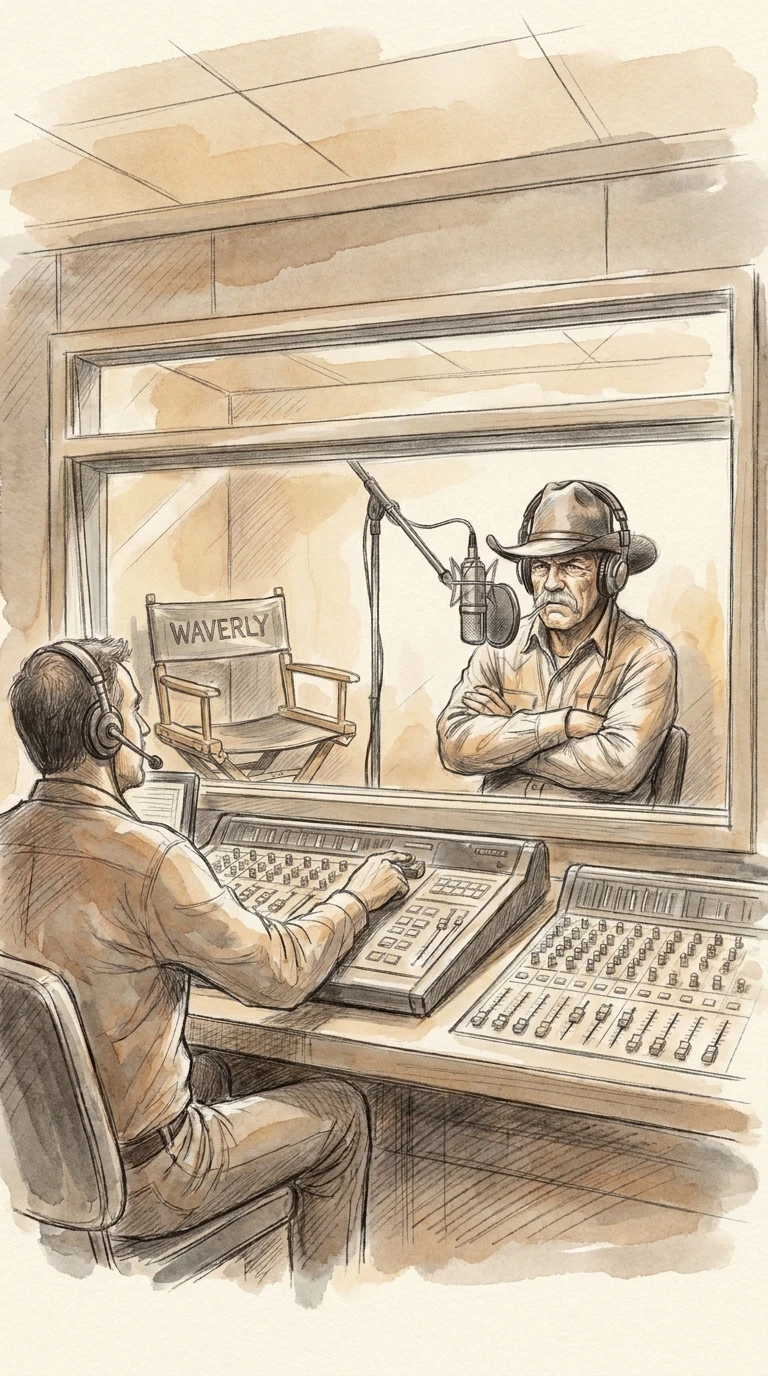
Ever wondered how Waverly got that voice? It took dozens of AI takes, some creative misspelling (“instrukshoonnel doo-SHINERS”), and a director’s ear. Now you can try it: diagnose a real take from the series, write your own direction, and hear what happens.
It’s adaptive e-learning in four microlearning modules, about 8 minutes each.
- Module 1: The Voice Detective
- Module 2: Timing and Attitude
- Module 3: You’re the Director
- Module 4: Scoring the Joke
How it adapts
- Each module scores your answers and chooses your path. Get the diagnosis right and you skip ahead to the director’s challenge; miss it and you get ear training first.
- A “Behind the Adaptation” panel shows you how each answer was scored and why the path went where it did.
- At the end, an AI coach checks the line you write, and an AI voice performs it.
About the production
Not a one-prompt miracle
These films combine human-written comic ideas with AI-assisted visual and voice production, iterative prompting and hands-on editing. Some of the funniest moments emerged from unexpected results, and from the decisions made about whether to repair, rework or embrace them.
Purpose → Prototype → Direct → Edit → Evaluate → Iterate
The interesting part is not what AI can generate. It’s what gets selected, rejected, rewritten, redirected, shortened, performed, edited and finally judged worth showing.
How the series was made
Tools come and go. The craft has to travel with you.
Voice direction. I directed Tough Guy’s voice performances in ElevenLabs v3. Most key lines took several takes, and I learned to steer delivery with the model’s built-in audio cues. Few people are teaching how to direct AI voice performances yet, so I built e-learning on it: Directing Waverly, at the top of this page.
A low-cost workaround. My Articulate Storyline subscription includes ElevenLabs voices, including Havoc, the voice of Waverly. So I direct and export his lines from a Storyline project I keep just for that purpose: legal, cheap and not at all obvious.
Animation. Tough Guy was first animated in HeyGen. When another month of HeyGen was out of budget, I moved to ElevenLabs’ avatar tools for the next five episodes. Tools come and go with pricing; the craft has to travel with you.
Production. I filmed the desk shots on a Canon EOS Rebel SL3, one of the most affordable DSLRs out there, lit with a Neewer photography light and umbrella. I recorded my own voice on a Rode NT-USB mic in Audacity with no processing, not even noise reduction. The room tone you hear is deliberate: the real, unpolished human beside an obviously synthetic Tough Guy. All editing was done in Camtasia.
Music. I played the tension chords throughout the series myself on a Yamaha EZ-220 and recorded them via MIDI into Cakewalk Sonar.
The opening. The intro began as a 14-second Sergio Leone-style title, which was far too long for a short this size. Working with ChatGPT, I cut it to 6 seconds. The pistol shot comes from my Yamaha EZ-220, the slap shot from a sound-effects library (hence the “Slap Shot Western”), and the breathy harmonica note from ElevenLabs.
Sound became part of the writing
Rhythm can carry the emotional turn.
The jaw-harp passage in the series is not really melodic. It works through rhythm: odd and comic at first, then increasingly unsettling as tempo and volume rise. The same sonic material changes emotional meaning without needing additional dialogue.
That discovery opens a larger production path: keyboard, electronic drums, rhythm, silence, stings, and recurring character cues can become part of the design rather than decoration added at the end.
Why this matters for learning design
Timing is instructional. A pause can make a learner notice. A rhythmic escalation can signal that an assumption is becoming absurd. A short sonic cue can create continuity across a series. These are small production choices, but they influence attention and interpretation.
Keep exploring
Back to the series.
Watch the eight episodes, or try the microlearning built on one of them.